

The Otamatone®, a quirky Japanese musical instrument, has captured the imagination of amateur and seasoned musicians alike. With a playful, toy-like design, it’s valued for its unique sound and interactive nature.
What is the Otamatone?
The Otamatone is a fun electronic musical instrument shaped like a giant eighth note. Play it by sliding your fingers along the neck to create sounds and change the pitch. You can also squeeze its head to open its mouth and change the tone. The Otamatone has a distinctive sound often described as a blend of string instruments and a synthesizer.
Several versions of the Otamatone exist, including the standard model, a mini version, and special editions with different designs and sounds.
History
Developed in Japan in 2009 by the art unit Maywa Denki and CUBE Works, the Otamatone became an unconventional addition to the world of musical instruments. Initially conceived as a novelty item, it quickly gained popularity, transcending cultural boundaries and captivating players worldwide.
Construction & Playing Techniques
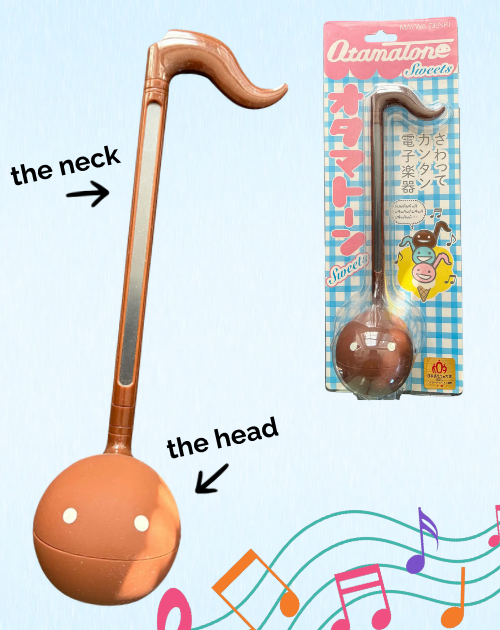
The Otamatone has two main parts: a head (the bulbous part that houses the speaker) and a neck (the long part with a touch-sensitive pitch strip). To play, simply slide your fingers along the neck to change the pitch, and squeeze the head to open its mouth and create the tone you want.
The instrument’s “neck” features a continuous, pressure-sensitive slide bar instead of individual keys, letting you control pitch and melody. Move your hand toward the top of the neck to produce lower notes, or closer to the head to produce higher notes. A switch on the back of the instrument allows you to toggle between three ranges: low, mid, and high.
The instrument’s “head” is made of soft rubber, shaped like a face, and houses the speaker while also acting as an acoustic filter. Squeezing the sides (or cheeks) of the head opens the mouth, changing the acoustic resonance and transforming the sound. By rapidly squeezing and releasing the head while playing notes on the neck, you can create its signature “wah-wah” effect or a more natural vibrato.
Global Popularity
By the mid-2010s, YouTube and social media had turned the Otamatone from a Japanese novelty into a global internet phenomenon. Because the Otamatone can play many styles of music, from pop and classical to experimental, viral song covers made its quirky buzz a staple of meme culture and online collaborations.
Learn More

Check out Musical Instruments from Around the World to learn more about unusual and fun instruments from diverse cultures and locations, including the Otamatone. Part of the Language Lizard Explore collection, it is available in both English and many bilingual editions. This multicultural book includes free lesson plans, extension activities, audio, and videos that let readers hear each instrument featured in the book. The book will appeal to all ages, especially older language learners.